4D Big vs Small: What Is the Difference?
# 4D Big vs Small: What Is the Difference?
1. The key point: Big and Small differ in prize-tier coverage
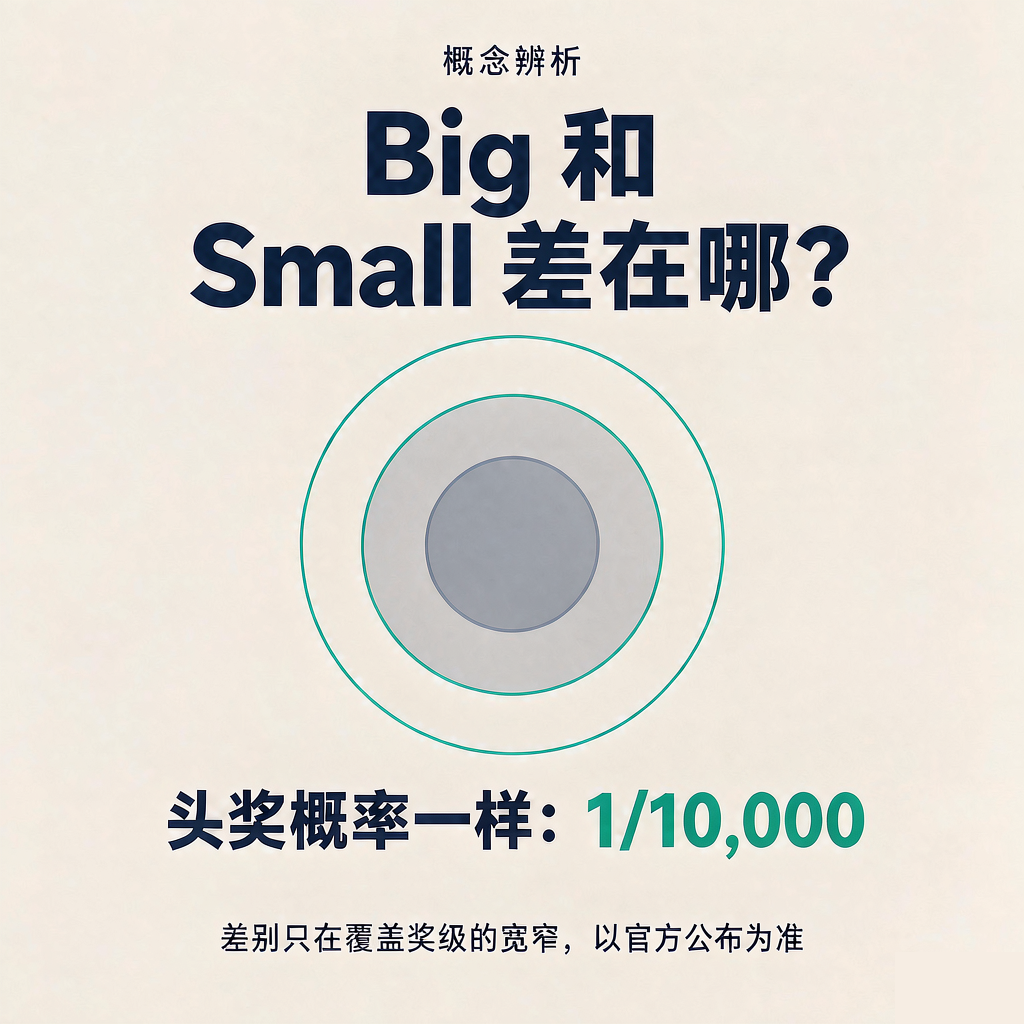
The same four-digit number can be played as Big or as Small. The core difference is not the top prize — it is how many prize tiers are covered.
Under the rules as published by the official source, Big covers a wider range of prize tiers than Small — Big extends down to the lower tiers, while Small covers only the higher tiers. In other words, the word "winning" means different things for the two play types: Big uses a wider definition, Small a narrower one.
| Play type | Prize tiers covered | In practice |
|---|---|---|
| Big | A wider range, extending down to the lower tiers | A wider definition of "winning" |
| Small | A narrower range, covering only the higher tiers | A narrower definition of "winning" |
The top-prize odds are identical for both — 1 in 10,000. This is the combinatorial probability (the probability derived from counting combinations) that a specific four-digit number is drawn as the top prize, and it is derivable from the 10,000 equally possible combinations without depending on any rule change. The difference is not here; it is in the "prize tiers covered" row of the table above.
> The number of tiers and the payout for each are as published by Singapore Pools; we publish no unverified values. The odds of "matching any prize tier" for Big and for Small depend on the tier structure and how many numbers are drawn — we do not expand on that here and we give no figures for it.
2. A quick recap of 4D: 0000–9999 and 10,000 combinations
To understand Big and Small, start with 4D itself: Under the rules as published by the official source, 4D is a four-digit game from 0000 to 9999, with 10,000 possible outcomes in total.
``` 10 × 10 × 10 × 10 = 10⁴ = 10,000 ```
Each position has 10 choices, 0 to 9, and the four positions are independent, so multiplying them gives the total. It follows that for any specific four-digit number, the probability of it being that draw's top prize is 1 in 10,000.
These two figures are the foundation of this article — both Big and Small play within the same space of 10,000 combinations; the only difference is how far down the tiers the word "winning" reaches.
3. Top-prize odds are 1 in 10,000 for both, but "any prize" odds differ
The top-prize odds are identical for both play types — 1 in 10,000. This is because the top prize depends only on whether your chosen number matches the top-prize number, not on whether you chose Big or Small.
But "matching any prize tier" is a different question. Under the rules as published by the official source, because Big covers a wider range of prize tiers than Small, the odds of Big matching any prize tier are higher than Small's — depending on the tier structure and how many numbers are drawn. We do not expand on that here and we give no figures for it.
This article contains no prize amounts or payout figures; the number of prize tiers and the payout for each are as published by Singapore Pools, and no unverified values appear here.
Two points are most often conflated:
1. It is a combinatorial probability, not an observed frequency. 1 in 10,000 comes from counting 10,000 equally possible combinations. It has nothing to do with how many draws have taken place and does not move with historical data. 2. Each draw is independent. The previous draw does not influence the next one. A number that has not appeared for a long time is not any more likely to appear — independent events have no memory.
4. Terminology warning: Starter is not Malaysia's "Special"
When reading about Big and Small, you will often see the word "Starter" — it is one of the lower prize tiers in Singapore 4D. Here is the warning: Singapore 4D uses Starter; the Malaysian 4D systems use "Special" for a different tier — the two are not the same thing, and carrying Malaysian material over to Singapore 4D leads to straightforward errors.
> Terminology warning: Singapore 4D uses Starter. The Malaysian 4D systems use "Special" for a different tier — the two are not the same thing; carrying Malaysian material over to Singapore 4D leads to straightforward errors.
5. Draw days and checking results
4D draw days are as published by the official Singapore source. For specific draw dates and times, please refer to official channels; we do not reproduce timing information that has not been verified.
6. What historical-data research and AI-assisted analysis do
Seeing the tier structure of Big and Small clearly is only the start. When you then want to see what those numbers look like across real history, going through records by hand is slow and easy to get wrong.
RND Lab | Random Number Lab structures the officially published draw history into something queryable, with AI-assisted analysis summaries — distributions, range structure, time-window comparisons — served in a readable form. Numbers you have logged are checked automatically after each draw against the published results.
RND Lab's role is to make that data readable, searchable and verifiable, so readers can reach their own conclusions from transparent information.
---
> 历史数据仅为描述性统计,每期开奖相互独立,不代表未来结果,不构成任何预测或投注建议。🔞 仅限 21+,请理性看待随机性。 > Historical data is descriptive only. Each draw is independent; past results do not predict the future. Not betting advice. 🔞 21+ only. Play responsibly.
---