
Setting Your Own Limits: Budget, Time and Self-Exclusion Tools
# Setting Your Own Limits: Budget, Time and Self-Exclusion Tools
1. The answer first: set your limits while you are calm
The single most useful move in responsible play is not willpower. It is making the decision in advance.
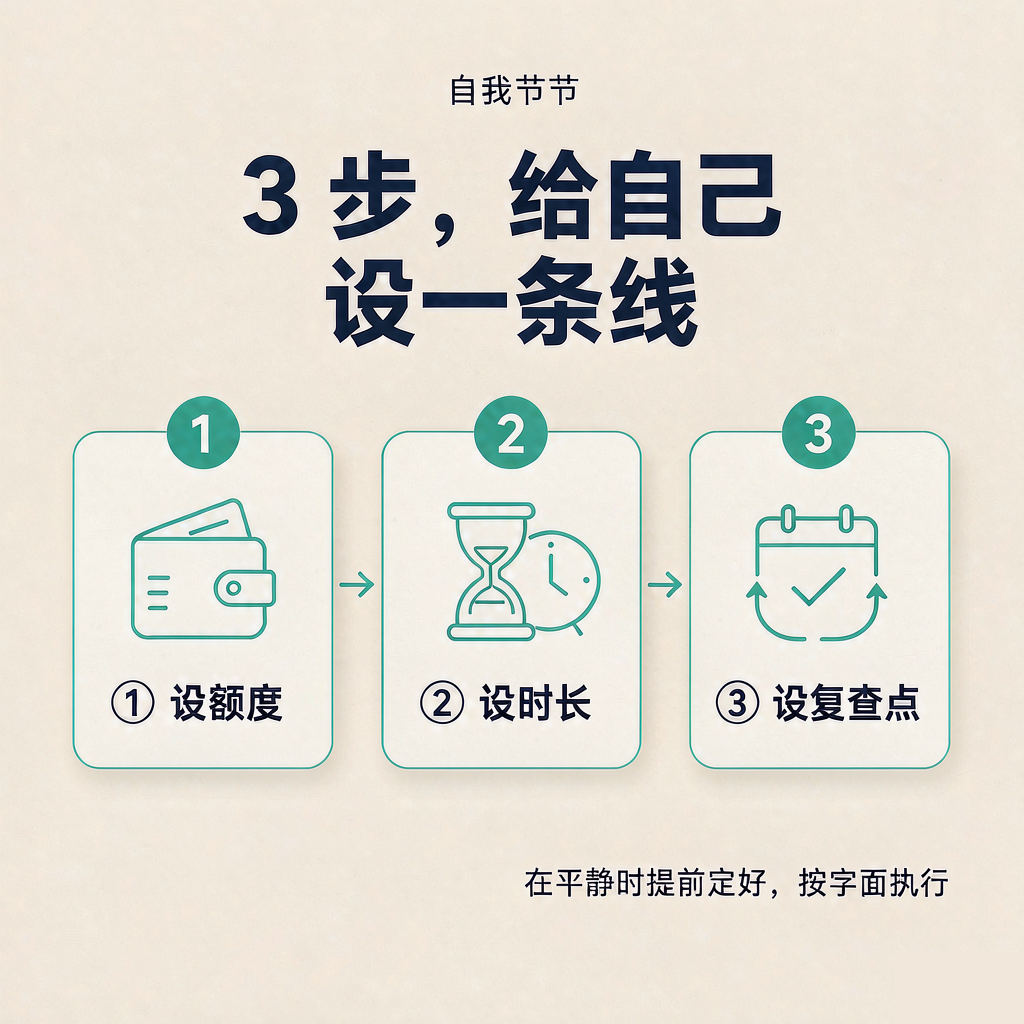
Set three limits — a budget line, a time line and a mood line — while you are calm and before you have opened any results page. Once they are written, follow them literally and do not renegotiate them in the moment. That is the one action this page wants you to use today; everything below explains why it works.
Further down: a three-step method you can copy directly, what self-exclusion tools actually do, seven signals that it is time to stop, and where to look for help.
> RND Lab | Random Number Lab structures the officially published draw history into queryable research charts with AI-assisted analysis summaries — distributions, range structure, time-window comparisons — and numbers you have logged are checked automatically after each draw.
A limit stored in a system and a limit kept in your head are different things. That is the point of this page.
> Per the official Singapore source, the minimum age to participate is 21; the specifics are as published by the official source. Everything here is written for readers aged 21 and over.
2. Three lines: budget, time, mood
#### 2.1 The budget line: set an affordable spending ceiling, not an outcome target
Limit breaches often begin when a ceiling is written as a target.
- Use a fixed share of disposable income — not rent, not bills, not savings, not your emergency fund. The test is simple: if the full amount were used up, nothing in your life would need rearranging.
- When the limit is reached, the period ends. Not extended because you came close, and not topped up from the next period.
- Records beat memory. Log the amount and the outcome each time, then review on a fixed cycle. Under-estimating your own spending is one reason limits can fail.
#### 2.2 The time line: time "research" and "decisions" separately
Mixing the two can make it easier to cross your time limit: you start by reading charts and end up making decisions.
- Two separate clocks. Research time is when you are reading charts and summaries; decision time is when you are choosing. Cap each one, and stop when each cap hits.
- When the time is up, stop rather than adding "one last look." Write down the stopping point in advance so it is not repeatedly extended in the moment.
- Count the waiting too. The stretch before and after a draw can amplify mood, and it belongs inside your time line as well.
#### 2.3 The mood line: treat a change in mood as a signal to stop early
Budget and time can be written down in advance. When your mood shifts, a pre-set stopping action becomes more important.
- Do not decide when angry, exhausted, or after drinking. These states can affect how people assess probability and risk, so pausing is safer than trying to persuade yourself in the moment.
- The urgency that follows a near miss can trigger a breach of your limits. It creates the feeling that one more attempt will even things out. Each draw is independent: the previous result has no bearing on the next.
- Give yourself a physical stopping action. What it is matters less than the fact that it is an action and not a thought — stand up, lock the screen, switch to something else. A defined action is easier to follow than an in-the-moment change of mind.
3. The three-step method (copy it as-is)
| Step | Do this | Where it lives |
|---|---|---|
| Step 1 · Set the amount | Fix a ceiling as a share of disposable income, and commit to it in writing | On paper |
| Step 2 · Set the time | Give research and decisions each a fixed window; when the alarm goes, you stop | An alarm |
| Step 3 · Set a review point | Review your log on a fixed cycle; if you breached, lower the next cycle's ceiling | Your log |
Step 3 is the one people often skip. A limit without a review point can drift upward without you noticing.
4. What self-exclusion tools actually do
"Self-exclusion" is not a slogan. It is a set of mechanisms that turn a promise into a constraint. Three common types:
| Type | What it does |
|---|---|
| Spending limits | You set a ceiling; once reached, the system stops accepting more |
| Time-based blocks | Cooling-off periods, time-outs, exclusion periods — during which participation is not possible |
| Reality-check reminders | Alerts at set intervals, plus an honest display of what you have actually spent |
They act at different points, but the principle is the same: let the calm version of you make the decision, and let the system enforce it so that the impulsive version of you cannot undo it.
> The length of exclusion periods, the range of limits available and the exact cooling-off rules are as published by the official source.
> Per the official Singapore source, arrangements for self-exclusion and for help are available in Singapore. Self-exclusion and support resources can be found through official channels; the specific entry points and contact details are as published by the official source.
5. Seven signals that it is time to stop
If any one of these shows up, end the period and go back to your three lines:
1. You are talking yourself into it with "the next one will even it out." Draws are independent. There is nothing to even out. 2. You are looking for ways to continue after the limit was reached. 3. You are borrowing money, or dipping into savings or your emergency fund. This is a hard boundary, not a matter of degree. 4. You are understating what you spent when family or friends ask. 5. You are missing work, sleep or commitments because of it. 6. Your mood rides on the result, and you are checking all day. 7. The reason has shifted from "it's fun" to "I need it."
Signals 3 and 7 need no self-assessment. If either is present, go straight to support resources — do not wait.
6. Why a near miss is not progress
Everything above rests on two facts you can check yourself.
Under the rules as published by the official source, a 4D number is a four-digit string from 0000 to 9999. Each position is 0–9, so `10⁴ = 10,000` combinations, and the combinatorial probability (the probability derived from counting combinations) that one specific four-digit number is the top prize in a single draw is 1 in 10,000.
Under the rules as published by the official source, TOTO asks you to choose 6 numbers out of 49, and the draw does not care about order: `C(49,6) = 13,983,816`, giving a top-prize combinatorial probability of 1 in 13,983,816. The derivation is based on the "6 out of 49" rule as published by the official source; if the rule changes, the denominator must be recalculated.
Two things follow:
1. Each draw is independent. The previous draw does not affect the next one. A number that has not appeared for a long time is not any more likely to appear — independent events have no memory. 2. A near miss is not a progress bar. Missing by one and missing by a mile face the same combinatorial probability in the next draw. It changes how a person feels; it does not change the combination count.
> The number of prize tiers and the payout for each are as published by Singapore Pools; we publish no unverified values.
7. What RND Lab does here
RND Lab | Random Number Lab works in three areas, all of them in service of one thing — letting you judge for yourself from verifiable information:
1. Historical-data research charts — the officially published draw history, structured and queryable: distributions, range structure, time-window comparisons. 2. Randomness education — the combinatorics and the independence, written so you can check the arithmetic yourself rather than take a conclusion on trust. 3. AI-assisted checking — numbers you have logged are checked automatically after each draw, removing the manual line-by-line comparison.
Historical data is valuable for describing past structure and variation. RND Lab organises those results into queryable, verifiable statistical views that help readers understand randomness and independence.
8. Where to find help
If you recognised yourself in Section 5 — especially in signals 3 or 7 — please do not carry it alone, and do not wait.
- Self-exclusion and support resources can be found through official channels; the specific entry points and contact details are as published by the official source.
- A person you trust counts as a resource. Telling someone you trust can help you take the next step.
- Start with the simplest step: find the official entry point and review the available self-exclusion arrangements. You do not need to wait until things feel serious; taking action while calm can make it easier to follow through.
> The specific entry points and contact details for these resources are as published by the official source.
---
> 历史数据仅为描述性统计,每期开奖相互独立,不代表未来结果,不构成任何预测或投注建议。🔞 仅限 21+,请理性看待随机性。 > Historical data is descriptive only. Each draw is independent; past results do not predict the future. Not betting advice. 🔞 21+ only. Play responsibly.
---