What is 4D? Singapore 4D Rules, Terms and Odds Explained
# What is 4D? Singapore 4D Rules, Terms and Odds Explained
1. The one number to start with
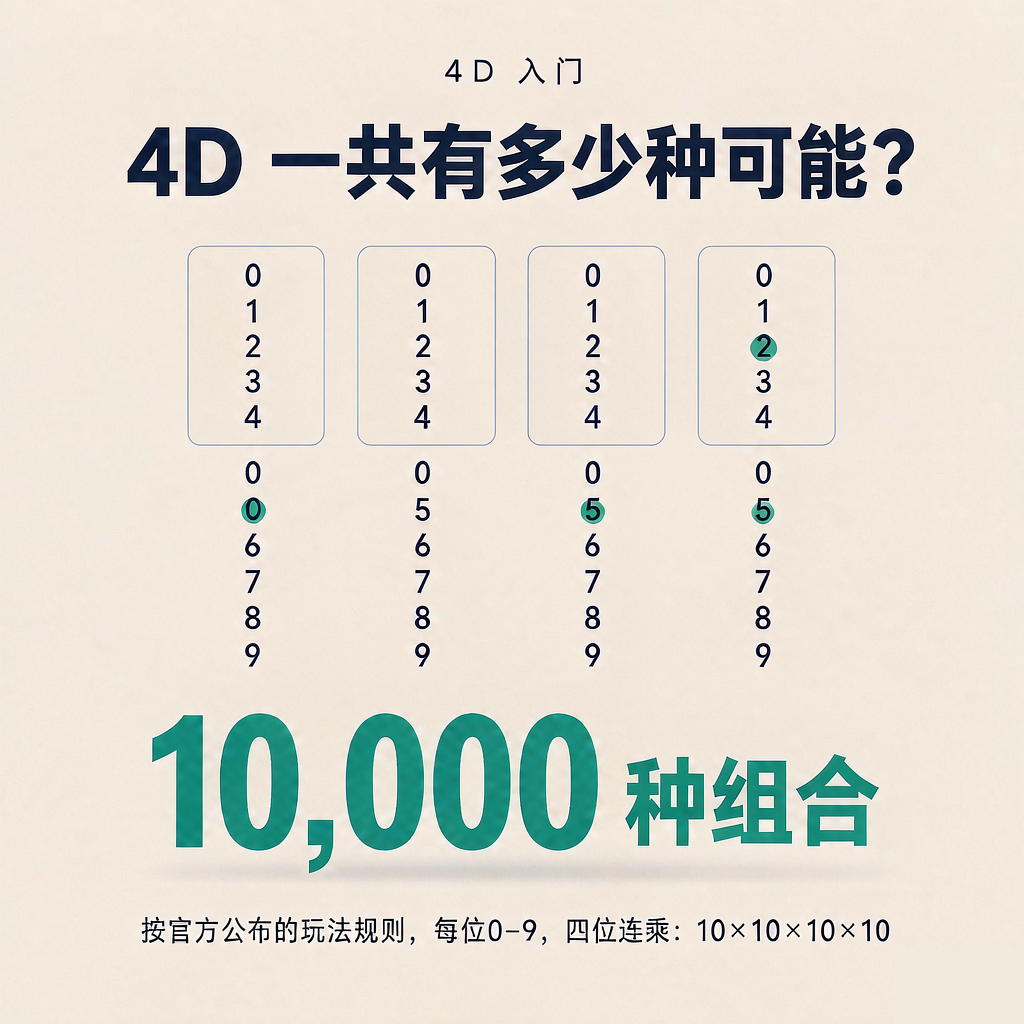
4D has exactly 10,000 possible outcomes. From 0000 to 9999, any four-digit number you choose is one of those 10,000 — and the combinatorial probability (the probability derived from counting combinations) that a specific four-digit number is drawn as the top prize in a single draw is 1 in 10,000.
These two figures are the foundation for everything else. Almost every question about how 4D is played, what the terms mean, and how the odds work can be traced back to them.
2. What 4D actually is
4D is Singapore's four-digit game. You pick one four-digit number from 0000 to 9999; the official draw publishes the winning numbers, and your number is matched against the published result.
Two details are most easily missed:
1. It is always four digits. "0123" and "123" are not the same number — leading zeros hold their position, and 0 has the same standing as any other digit. 2. One number is one bet. You hold a specific four-digit value, not a range of numbers and not a set of numbers.
3. Where 10,000 comes from
Each of the four positions has 10 options, 0 to 9:
``` 10 × 10 × 10 × 10 = 10⁴ = 10,000 ```
This is not an estimate but an exhaustive count: the four positions are chosen independently, so multiplying them gives the total.
Two conclusions follow directly:
- For any specific four-digit number, the probability of it being that draw's top prize is 1 in 10,000;
- Put the other way, for a fixed number there are 9,999 ways in which a draw does *not* produce it as the top prize.
4. Big and Small: two ways to play
The same four-digit number can be played as Big or as Small. The core difference is how many prize tiers are covered:
| Play type | Prize tiers covered | In practice |
|---|---|---|
| Big | More tiers, extending down to the lower ones | A wider definition of "winning" |
| Small | Fewer tiers, covering only the higher ones | A narrower definition of "winning" |
The top-prize odds are identical for both — 1 in 10,000. The difference is not in the top prize; it is in how far down the tiers the word "winning" reaches.
> The number of tiers and the payout for each are as published by Singapore Pools; we publish no unverified values.
5. Glossary (English term + Chinese explanation)
| English term | 中文解释 / Chinese explanation |
|---|---|
| Ordinary | 选一个四位数字投一注,最基础的投注形式。A single four-digit number, one bet — the basic form. |
| System | 把你选定数字的全部排列一次性覆盖。Covers every permutation of your chosen digits in one entry: coverage and cost rise in the same proportion. |
| iBet | 把一份投注额分摊到多个排列上。Spreads one stake across several permutations: payouts divided accordingly. |
| 4D Roll | 固定部分数位,其余位在 0–9 中依次轮转。Holds part of the number fixed while the remaining positions rotate through 0–9, producing a set of numbers. |
| QuickPick | 由系统随机生成一个四位数字。A four-digit number generated at random by the system, not chosen by hand. |
| Starter | 入门奖,新加坡 4D 中较低的奖级之一。One of the lower prize tiers in Singapore 4D. |
> Terminology warning: Singapore 4D uses Starter. The Malaysian 4D systems use "Special" for a different tier — the two are not the same thing; carrying Malaysian material over to Singapore 4D leads to straightforward errors.
One common misunderstanding worth clearing up: System and iBet change your coverage, not your advantage. You hold more combinations, and your cost rises by exactly the same factor. The two scale in strict proportion.
6. What 1 in 10,000 really means
Three points are most often conflated:
1. "Winning the top prize" and "winning any prize" are different questions. The top prize is 1 in 10,000. Since a draw produces several numbers, winning *something* is materially more likely. Before quoting any odds, say which of the two you mean. 2. It is a combinatorial probability, not an observed frequency. 1 in 10,000 comes from counting 10,000 equally possible combinations. It has nothing to do with how many draws have taken place and does not move with historical data. 3. Each draw is independent. The previous draw does not influence the next one. A number that has not appeared for a long time is not any more likely to appear — independent events have no memory.
> This article states only the directly derivable top-prize probability of 1 in 10,000. The probability of winning any prize depends on how many numbers a draw produces and on the tier structure — as published by Singapore Pools — so no unverified figures appear here.
7. Draw days and checking results
4D draw days are as published by the official Singapore source. For specific draw dates and times, please refer to official channels; we do not reproduce timing information that has not been verified.
8. What historical-data research and AI-assisted analysis do
Working out the odds is only the start. When you then want to see what those numbers look like across real history, going through records by hand is slow and easy to get wrong.
RND Lab | Random Number Lab structures the officially published draw history into something queryable, with AI-assisted analysis summaries — distributions, range structure, time-window comparisons — served in a readable form. Numbers you have logged are checked automatically after each draw against the published results.
RND Lab's role is to make that data readable, searchable and verifiable, so readers can reach their own conclusions from transparent information.
---
> 历史数据仅为描述性统计,每期开奖相互独立,不代表未来结果,不构成任何预测或投注建议。🔞 仅限 21+,请理性看待随机性。 > Historical data is descriptive only. Each draw is independent; past results do not predict the future. Not betting advice. 🔞 21+ only. Play responsibly.
---